Do HVAC Companies Really Need a Website in 2026?

Do HVAC Companies Really Need a Website in 2026?
If you run an HVAC business, you've probably built a solid chunk of your customer base through word of mouth, repeat business, and maybe a few referral sources who send you work consistently. It's worked. Why mess with it?
It's a fair question, and I'm not going to give you a canned answer.
The honest truth is that some HVAC companies genuinely don't need a website. If you're a one-truck operation with more calls than you can handle, the last thing you need is more leads.
But HVAC has some specific characteristics that make the conversation a little different than it is for most trades, and I think it's worth walking through them, because for a lot of HVAC companies, not having a website is costing them in ways they don't see until they look for them.
Let's get into it.
When Referrals Are Genuinely Enough
First, the honest version of this.
If you're booked three weeks out, your repeat customers fill your maintenance schedule every spring and fall, and you've got a few commercial accounts that keep your crew busy between service calls: you might not need a website right now. You need to raise your rates, hire a tech, or both.
Referral-based businesses have real advantages. The leads that come in are already warm. Your close rate is higher. Your marketing cost is zero. And you can spend your mental energy running a good operation instead of thinking about how to get your name in front of strangers.
I want to acknowledge that before I make any other point. But here's what I've noticed after working with a lot of service businesses: the HVAC companies that feel the most secure when things are slow are the ones who aren't depending entirely on their existing network to keep the phone ringing.
There Are Three Completely Different Buyers Looking for You Online
This is something specific to HVAC that's worth understanding before we talk about websites at all.
Most trades have one type of customer. A plumber gets a call, they fix something, job done. But an HVAC company is typically dealing with three very different buyer types, and each one searches online differently.
The emergency caller. It's 11pm in January. The heat stopped working. There's a child or an elderly parent in the house. This person is not calling their neighbor for a recommendation. They are Googling "emergency HVAC near me" or "furnace not working [city]" and calling the first company that looks like it can actually help them right now.
The replacement shopper. Their system is 18 years old and the tech just told them it's on its last legs. They're going to replace it, but they're going to do some research first. They want to compare a few options, understand what brands you install, maybe read a few reviews. This is a $6,000-$15,000 decision. They're not rushing.
The maintenance contract prospect. This is the one most HVAC companies underestimate. There are homeowners out there actively looking to get on a maintenance program. Maybe they just bought a house, their manufacturer warranty requires annual service, or they've had enough breakdowns that they want proactive care. These people are searching "HVAC maintenance plan [city]" or "AC tune-up near me" and signing up with whoever they find first.
Each of these three buyers is looking for something slightly different from you online. A website gives you the space to speak to all of them. Without one, you're only reachable to people who already know your name.
The 2am Call You're Missing
Let me be specific about the emergency scenario, because I think it gets undersold.
An HVAC emergency doesn't wait for business hours. It happens on the coldest night in February, on the hottest afternoon in August, on Christmas morning when family is visiting and the furnace decides to quit. And when it happens, whoever needs help is doing one thing: searching their phone for someone who can come now.
If you don't show up in that search, that call goes to someone else. Not necessarily the best HVAC company in your market, just the one that's findable. Every emergency job you miss because a homeowner couldn't find you online is a job you lost without ever knowing it was there. For HVAC companies, those emergency calls are often the highest-margin work you do, because urgency doesn't negotiate.
Even Your Repeat Customers Are Searching for You
Here's something that comes up in almost every conversation I have with contractors: your existing customers are still Googling you.
They want to send a friend your number and they can't find it in their phone. They want to leave you a review and need to find your profile. They're trying to remember your company name to tell a coworker. The first thing most of them do is search for you.
What do they find?
If they find a clean website with your number in the header and a link to your Google reviews, you look exactly as professional as you actually are. If they find nothing, or an old Facebook page you haven't updated in two years, you've created friction at the worst possible moment, right when someone is already trying to refer you.
A website makes it easy to be found by the people who already like you, not just the ones who don't know you yet.
The Maintenance Contract Opportunity
This is the angle that I think most HVAC companies leave entirely on the table when they're not thinking about their online presence.
Maintenance agreements are the closest thing HVAC has to recurring revenue. A homeowner on a service plan calls you first when something breaks. You're getting paid every year whether anything breaks or not. You're the HVAC company for that household for the next decade.
But homeowners who want this kind of relationship have to be able to find you first. A lot of them are searching. "HVAC maintenance plan [city]," "AC tune-up service near me," "furnace service agreement": these are real searches that real homeowners are making right now. If you have a maintenance program but no online presence, you're invisible to every potential long-term customer who doesn't already know your name.
A single page on your website dedicated to your maintenance offerings, covering what's included, how it works, and what it costs, can generate the kind of customer that's worth five times what a one-time repair is worth. That's a page most HVAC websites don't have, because most HVAC companies don't have a website at all.
The Shoulder Season Problem
If you've been in HVAC long enough, you know what March and October look like. The heating season is winding down or the cooling season hasn't started yet, and the phone slows down.
This is where the feast-or-famine cycle shows up in HVAC specifically. The busy seasons take care of themselves. The shoulder months are where you feel the gap.
Referrals are unpredictable by nature. A happy customer might mention you to a friend during shoulder season, or they might not think of it for six more months. You can't control the timing.
A website generating leads from search fills in that gap whether it's a peak month or a slow one. It captures the homeowner who decided during a mild April that they want to get their AC serviced before summer. It captures the person who started researching a new system in March because they know summer is coming. It keeps your calendar from going completely quiet between seasons.
"But I Have a Google Business Profile"
Good, you should. A fully optimized Google Business Profile is one of the highest-ROI things an HVAC company can set up. It's free, it gets you in front of people who are actively searching, and it's where your reviews live. I recommend it to every client on day one.
But here's the thing: a GBP profile and a website aren't doing the same job. They're two different parts of the same funnel.
Your Google Business Profile is what gets people to find you. Your website is what gets them to call you.
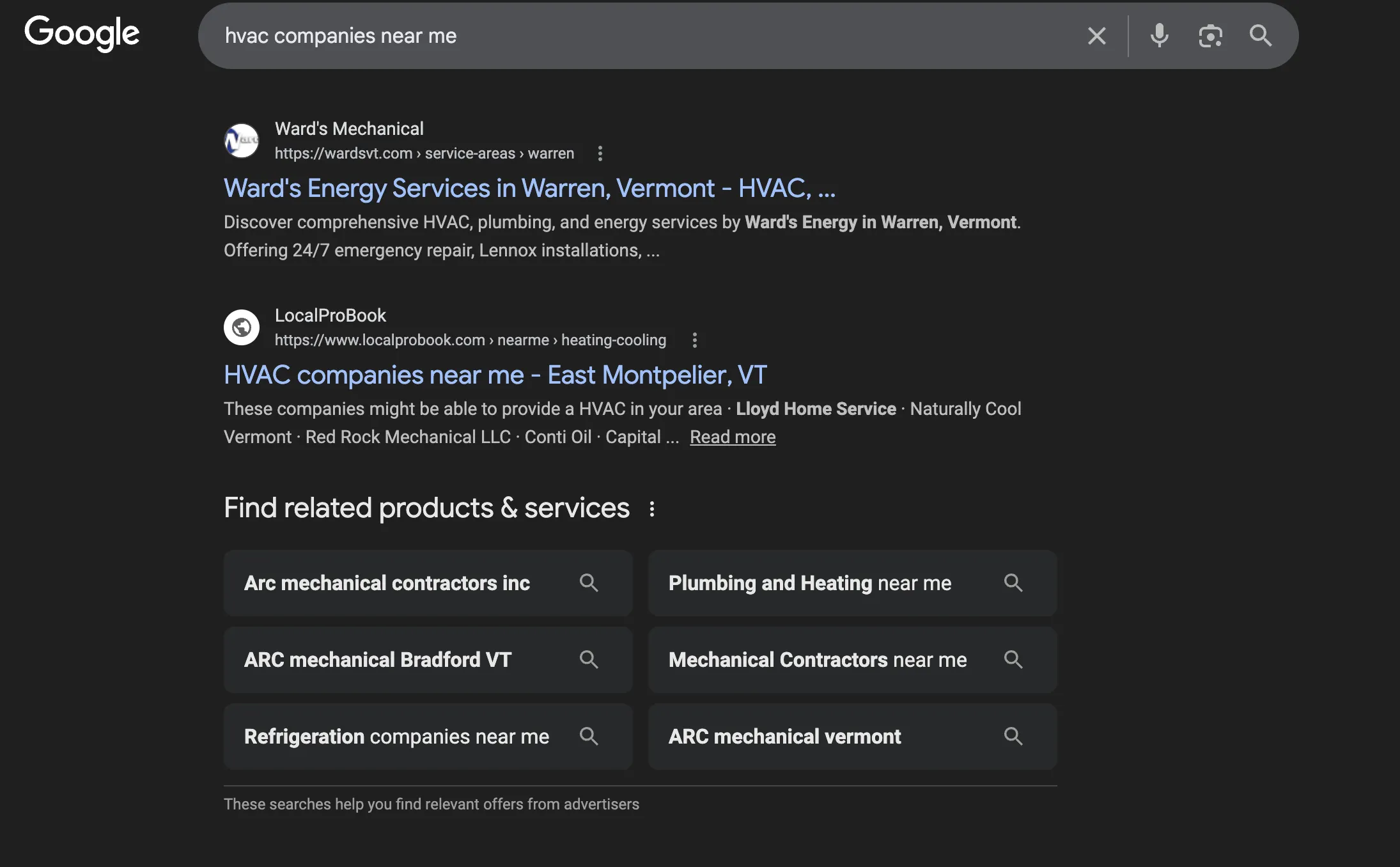
Think about what actually happens when someone searches "HVAC company near me." They get a map with three listings and a list below it. They scan the star ratings, maybe look at a photo or two, and then, especially if this is a bigger decision like a system replacement, they click through to your website to do a little more research before they commit to calling.
That click-through is where you either win or lose the job.
If they land on a professional website that clearly lists your services, shows photos of your team, answers their financing question, explains your maintenance program, and makes it effortless to call you, you're the obvious choice. If they hit a dead end because you don't have a website, or land on something that looks like it was built in 2011, they go back to the list and call the next company.
Your GBP gets the traffic. Your website converts it into customers.
The other thing worth saying: a GBP listing alone can only tell someone you exist. It can't walk a homeowner through what to expect from a system replacement, address the financing question that comes up on every $10,000 install, or explain what's included in your maintenance plan. That's the work a website does, and it's the work that turns someone who found you into someone who hired you.
What an HVAC Website Actually Needs
You don't need a complicated website. The simpler ones usually work better. Here's what actually matters:
Your services, clearly listed. Heating repair, AC repair, installation, maintenance agreements: list what you do. Don't make people guess whether you handle commercial work or just residential, whether you do ductless mini-splits, whether you service all brands. Answer the questions before they're asked.
Your phone number, everywhere. Header, footer, homepage, everywhere. HVAC calls are often urgent. The second someone has to hunt for your number is the second they might call someone else.
Photos of your work and your team. HVAC installs aren't always glamorous, but a photo of a clean equipment room, a new air handler, or a well-done ductwork job shows you take the work seriously. A photo of your team, even just your crew standing in front of a truck, goes a long way toward making you feel like real people rather than a generic listing.
Customer reviews on the page. Feature two or three of your best Google reviews directly on your homepage. Social proof from local homeowners is the most persuasive thing on your website. If someone sees that their neighbor on the next street over left you a five-star review, that matters more than anything you could write about yourself.
Your service area. List the cities and towns you cover. This helps local SEO and immediately tells people whether you can help them.
A dedicated maintenance plan page. If you offer service agreements (and if you don't, you should), give it its own page. Explain what's included, how often service happens, and how to sign up. This page can generate recurring revenue on its own.
That's the core of it. You don't need a blog on day one. You don't need animations or a chatbot or a complicated booking system. A fast, clean, mobile-friendly website with those elements will outperform the majority of HVAC websites in any market. Not sure what to write? Our free contractor copy generator can get you a solid homepage draft in a few minutes.
The Cost Reality
I've done a full breakdown on website pricing in a separate article, which you can read here. The short version: DIY platforms like Wix or Squarespace run $200-500 a year plus significant time investment. A freelancer is typically $2,000-5,000 to build, plus maintenance on top of that. Agencies start around $8,000. My own subscription model runs $175 a month with no upfront cost, which includes the build, hosting, maintenance, and support.
Here's how to think about the ROI: if your average system replacement is $8,000 and a website generates you one additional installation job per month that you wouldn't have gotten otherwise, it's paying for itself by a factor of 40 or more. Even for smaller service calls, the math works fast. The question isn't really whether you can afford a website. It's whether you can afford to keep being invisible to customers who are actively searching for exactly what you offer.
So, Do You Actually Need One?
If your dispatch board is full, your maintenance customers are happy, and your referral network is strong with no sign of slowing, you might genuinely be fine. I'll say that honestly, because I'm not in the business of selling people things they don't need.
But if your shoulder seasons are slower than you'd like, if you've ever lost a job to a competitor you know you could have outperformed, or if you've thought about adding maintenance agreements and don't have a clear way to market them: a website is probably worth more than you think.
It doesn't replace good work, a good reputation, or good customer service. But it makes sure all of that gets seen by the people who are looking for it.
If you want to talk through what makes sense for your specific situation, I'm happy to. No pressure, no pitch, just an honest conversation about what might actually help. Reach out here.
Frequently Asked Questions
What should an HVAC company website include?
At minimum: a clear list of your services, your phone number in the header, your service area, a few customer reviews, and photos of your team or your work. If you offer maintenance agreements, give that its own dedicated page. It's worth the space.
How much does an HVAC website cost to build?
It depends on your approach. DIY platforms run $200-500 a year plus your time. A freelancer typically charges $2,000-5,000. Agencies start around $8,000. My subscription model is $175 a month with no upfront cost, which covers the build, hosting, maintenance, and support.
Do I need online booking on my HVAC website?
It can be a nice feature, especially for scheduling maintenance visits. But it's not essential to start. A prominently displayed phone number and a simple contact form handle the majority of inbound leads just fine. Add booking functionality later if there's demand for it.
How do I get my HVAC company to rank on Google?
It's a two-part system. Your Google Business Profile is what gets you in front of people searching locally. Make sure it's fully filled out with accurate service areas, real photos, and consistent review collection. Your website is what converts that traffic into actual customers. It's where people go after they find your GBP listing to decide whether to call you. Reviews are the biggest ranking factor in the local map pack, so building those consistently is the highest-leverage thing you can do alongside having a solid website to send people to.
How long does it take for an HVAC website to generate leads?
Most HVAC companies start seeing some inbound traffic within a few weeks of launching. Meaningful, consistent leads from organic search typically take two to four months to develop, depending on competition in your market. Emergency-related searches can drive leads faster, since those queries convert quickly and don't always favor the most established sites, just the ones that show up.
Should I have a page about my maintenance agreements?
Yes, and I'd make it a priority. Maintenance agreement customers are your most valuable customers. They renew annually, they call you first when something breaks, and they refer their friends. Give that page its own space on your site and treat it like a service offering, not an afterthought.