
Do Plumbers Really Need a Website in 2026?

Do Plumbers Really Need a Website in 2026?
If you're a plumber, you've probably heard some version of this advice before: "You need a website to grow your business." And maybe you've pushed back with something like:
"I've been doing this for 15 years and I've never needed one. All my work comes from referrals."
I get it. And honestly? You might be right.
I talk to plumbers all the time who've built solid businesses without ever having a website. Guys who stay busy year-round, have a reputation in their community, and get all the work they need from word of mouth and repeat customers.
So I'm not going to sit here and tell you that you absolutely, 100% need a website. That would be dishonest.
What I am going to do is help you figure out whether a website actually makes sense for your situation. Because for a lot of plumbers, not having one is costing them money they don't even realize they're losing.
Let's break it down.
When Referrals Are Genuinely Enough
Before I make the case for having a website, let's acknowledge when referrals really are sufficient.
If you're a one-person shop and you're already turning away work, you don't need more leads. You need to raise your prices.
If you're in a small town where everyone knows everyone and your reputation precedes you, that network might be all you need. If you're a few years from retirement and you're not trying to grow or sell the business, investing in a website might not make sense for you.
There are real advantages to running on referrals. Your marketing costs are zero. The leads that come in are already warm because someone vouched for you. Your close rate is higher. And you don't have to think about marketing at all.
If that's your situation, you might genuinely be fine without a website.
But here's where it gets complicated.
The Hidden Cost of Being Invisible Online
Even if referrals are working for you, there's an invisible cost to not existing online that most plumbers don't think about.
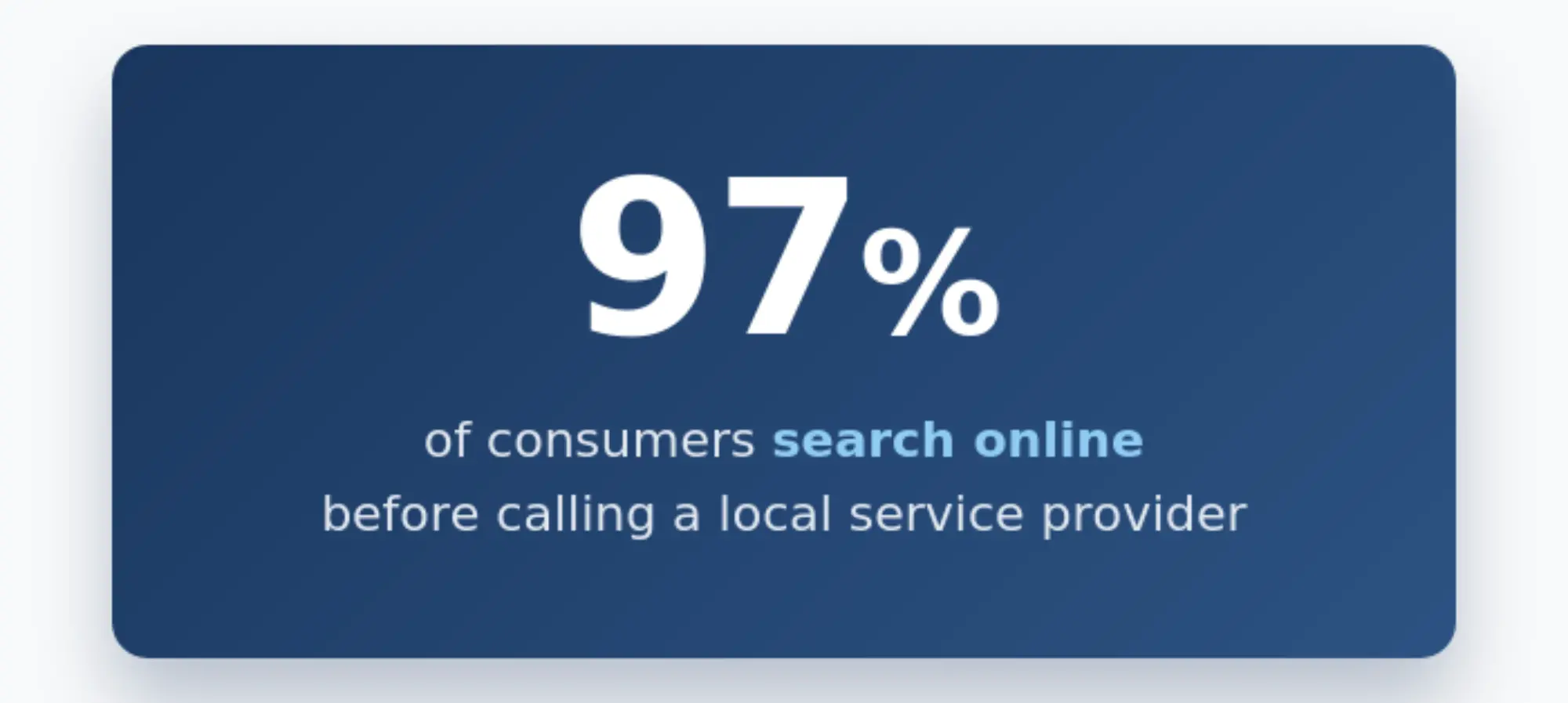
Here's the reality: 97% of consumers search online for local services before making a call. 76% of people who search for a local business on their phone visit or call within 24 hours. And nearly half of all Google searches have local intent — things like "plumber near me" or "emergency plumber [city name]."
Let me paint you a picture.
It's 6am on a Saturday. A homeowner wakes up to find water pouring through their kitchen ceiling. There's a burst pipe somewhere, and they need help now. They're not going to text their neighbor and wait for a response. They're not going to scroll through Facebook hoping someone has a recommendation. They're grabbing their phone and searching "emergency plumber near me."
If you don't show up in that search, you don't exist in that moment. The job goes to someone else — maybe a plumber with half your experience and twice your prices — simply because they showed up and you didn't.
That's an $800 emergency call you never even knew about. Multiply that by a few times a month, and the invisible cost adds up fast.
Plumbing is one of those trades where emergencies drive a huge chunk of the business. Burst pipes don't wait for business hours. Water heaters fail on holiday weekends. Sewer backups happen at the worst possible times. And when they do, people search.
If you're not findable in those moments, you're leaving money on the table every single week.
Even Your Referrals Are Googling You
Here's something a lot of plumbers don't realize: even the people who get your name from a friend are going to Google you before they call.
Think about it. Someone's coworker says, "You should call Dave — he fixed our water heater last year and did a great job." What's the first thing that person does? They pull out their phone and search "Dave's Plumbing" or "Dave Thompson plumber" to check you out.
What are they going to find?
If they find a professional website with photos of your work, your licensing info, and some testimonials, that confirms the trust your referral already built. They call you feeling confident.
If they find a Facebook page you haven't updated since 2023, they might still call, but you've lost some credibility before the conversation even starts.
If they find literally nothing? Some people will call anyway. But a lot of them won't. They'll feel uncertain, wonder if you're still in business, and move on to someone who looks more established.
Here's a quick exercise: Google your own business name right now. Is that the first impression you want potential customers to have?
The Trust Factor in Plumbing
This is something that makes plumbing different from a lot of other trades.
When someone hires a plumber, they're inviting a stranger into their home. Often into the most private parts of their home — bathrooms, basements, crawl spaces. That requires a level of trust that doesn't exist in a lot of other service businesses.
A website gives you a chance to build that trust before you ever show up at someone's door.
You can show photos of yourself and your team. You can display your license number, insurance information, and any certifications you have. You can share reviews from past customers. You can explain how long you've been in business and what areas you serve.
All of this works to answer the unspoken questions running through a potential customer's mind: Is this person legitimate? Are they going to show up on time? Are they going to charge me fairly? Can I trust them in my house?
Without a website, you're asking people to take all of that on faith. Some will. A lot won't.
The Feast-or-Famine Problem
If you've been plumbing for any length of time, you know the pattern. Some months you're slammed — can't answer the phone fast enough. Other months it's quiet and you're wondering where the next job is coming from.
This is the feast-or-famine cycle, and it's built into referral-dependent businesses.
The problem is that referrals are slow. A happy customer might mention your name to a friend six months from now, or they might not mention you at all. You can't control the timing, and you can't scale it. There's a natural ceiling based on how many people your past customers happen to talk to.
A website changes that equation because it works while you're working. Someone can find you at 11pm on a Sunday, read about your services, check out your reviews, and send you a message. You wake up Monday morning with a lead you didn't have to lift a finger for.
And unlike referrals, a website compounds over time. The longer it exists and the more content and reviews you build up, the more visible it becomes. Referrals trickle in. A good website builds momentum.
"But I Have a Facebook Page"
I hear this one a lot. And look, having a Facebook page is better than having nothing. But it's not a replacement for a website.
The biggest issue is that Facebook doesn't show up in "near me" searches. When someone searches "plumber near me" on Google, they see websites and Google Business Profiles. They don't see Facebook pages. So if Facebook is your only online presence, you're invisible to everyone who's actively searching for a plumber in their area.
There's also the ownership problem. Facebook is rented land. You don't control it. They change their algorithm constantly, and organic reach has cratered over the years. They could change their policies, start charging businesses, or suspend your page for some unclear reason — and you'd have no recourse.
And honestly? A Facebook-only business can look less established. Fair or not, some people will see a Facebook page and think "side hustle" instead of "professional plumber." It shouldn't matter, but first impressions are hard to shake.
Facebook is useful for staying connected with past customers, sharing project photos, and running targeted ads. But think of it as a supplement to your website, not a substitute for one.
What About Just Google Business Profile?
This is a more interesting question, because Google Business Profile is actually pretty powerful for local businesses. And it's free.
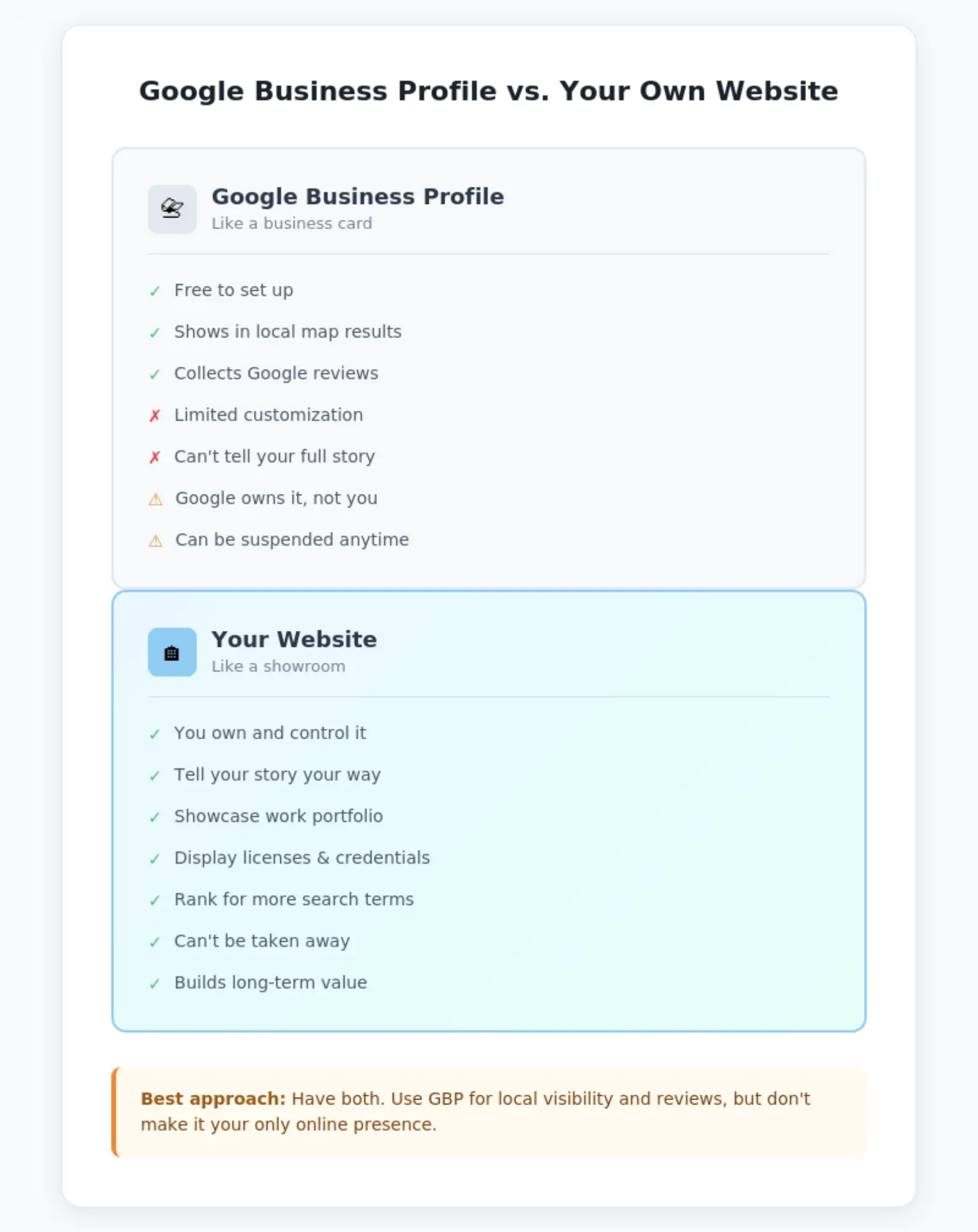
If you're just starting out and have zero budget, setting up a Google Business Profile is the single highest-ROI thing you can do. It shows up in local search results, it lets you collect reviews, and it gives people basic information about your business. For some very small operations, this genuinely might be enough for a while.
But there are limitations.
With a Google Business Profile alone, you can't really control the narrative. You get a few fields to fill out, but you can't explain your process, show a detailed portfolio of jobs, tell your story, or differentiate yourself from the ten other plumbers in the same list.
You're also competing in a box where everyone looks basically the same. It comes down to reviews, proximity, and who happens to show up first. You can't guide someone through why they should choose you over the next guy.
And here's what makes me nervous about relying on GBP alone: you don't own it.
Profiles get suspended all the time, sometimes for reasons that make sense and sometimes for no apparent reason. I've talked to plumbers who woke up one morning to find their listing gone — no warning, no explanation, just a form to fill out and weeks of waiting to maybe get it back. If that listing is your entire online presence, you're starting from zero while your competitors keep getting calls.
The point isn't that Google Business Profile is bad. It's genuinely useful, and you should absolutely have one. But building your entire online presence on a platform you don't control is risky.
Think of it this way: a Google Business Profile is like a business card. A website is like a showroom. Both serve a purpose, but they do very different jobs. And only one of them can't be taken away without warning.
The Real Questions to Ask Yourself
Instead of asking "do I need a website," I think there are better questions to consider.
Are you turning away work right now? If you're genuinely booked solid and can't take on more, you might not need additional leads. But if you've got capacity and you're waiting for the phone to ring, that's a lead generation problem.
Where do you want to be in three years? If you're happy at your current size and don't have ambitions to grow, referrals might be enough. But if you want to expand, hire help, or eventually sell the business, you need predictable lead flow — and that's hard to build on referrals alone.
What happens if your referral network dries up? Key customers move away. Your best referrer retires. The economy shifts. How resilient is your business if word of mouth slows down?
Are you competing against plumbers who have websites? If your competitors are investing in their online presence and you're not, you're ceding ground every single day. Every time someone searches for a plumber and finds them instead of you, that's a job you lost without even knowing it.
Here's a simple test: search "plumber [your city]" right now. Look at who shows up. Those are the plumbers getting the calls you're not getting. Are you okay with that?
What a Plumber's Website Actually Needs
If you're starting to think a website might make sense, I don't want you to feel overwhelmed. Plumber websites don't need to be complicated. In fact, the simpler ones often work better.
Here's what you actually need.
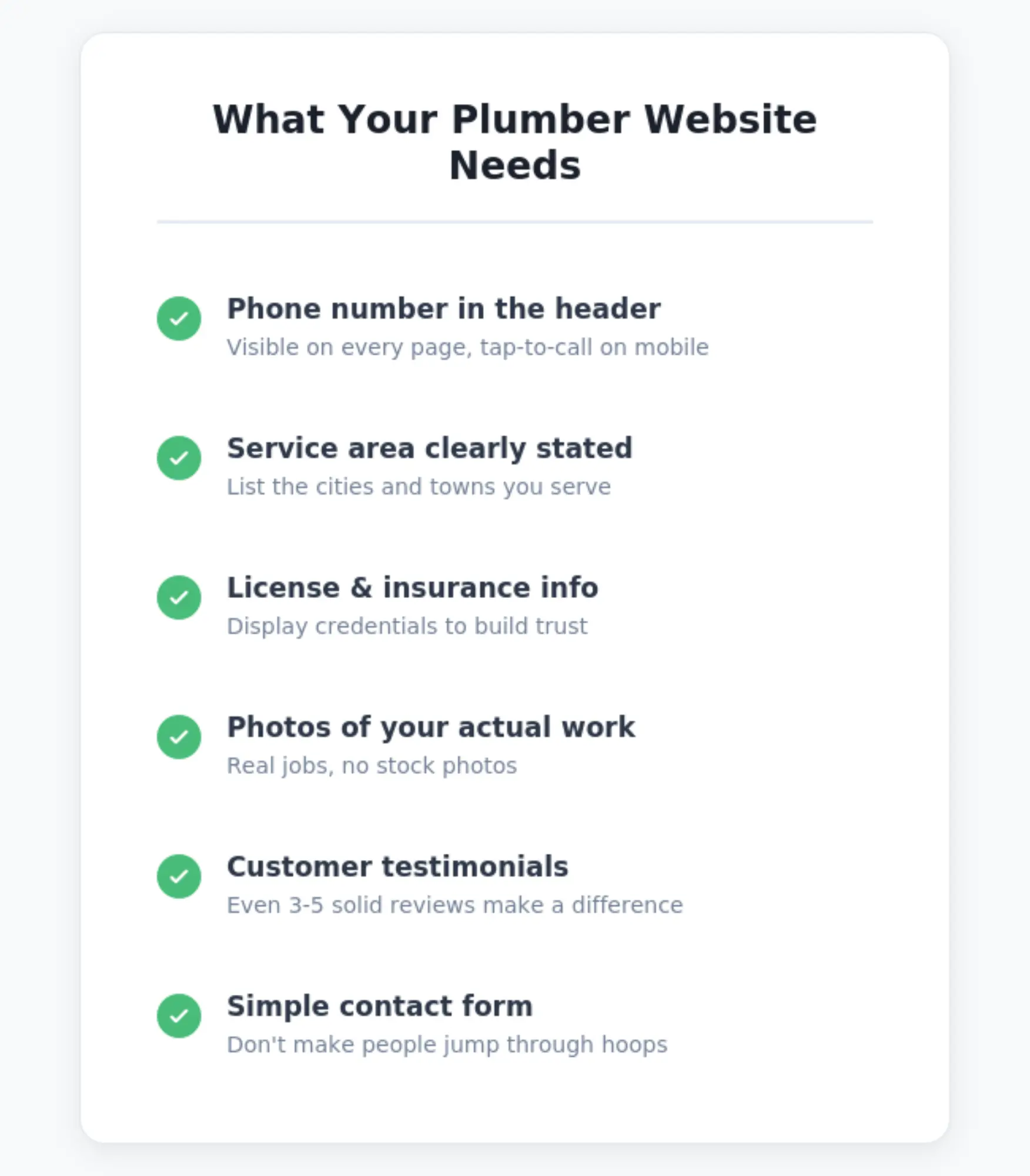
A clear statement of what you do and where you do it. Something like "Licensed plumber serving the greater Burlington area — available 24/7 for emergencies." Sounds obvious, but you'd be surprised how many plumber websites make you hunt for this basic information.
Your phone number visible on every page. Not buried in a contact page. In the header, where people can see it and tap it immediately on mobile. For plumbing especially, a lot of your calls are urgent. Make it easy.
Your licensing and insurance information. This is a trust signal. Display your license number, mention that you're insured and bonded. It reassures people that you're legitimate and protects them if something goes wrong.
Photos of your actual work. Real jobs you've completed. I know plumbing isn't always photogenic — nobody wants to see a close-up of a drain clog. But before-and-after shots of water heater installs, bathroom rough-ins, or pipe repairs show that you know what you're doing. No stock photos of smiling plumbers with wrenches. Real work builds real trust.
A few testimonials. Even three to five solid reviews make a difference. People want to know that others have had good experiences with you. If you've got good reviews on Google, showcase them on your site too.
Your service area. List the cities and towns you serve. This helps with local SEO and tells potential customers immediately whether you can help them.
A simple way to contact you. Phone number, basic contact form, or both. Don't make people jump through hoops. If you offer 24/7 emergency service, make that obvious.
That's really it. You don't need a blog. You don't need fancy animations. You don't need twenty pages of content. A fast, clean, mobile-friendly site with your phone number and photos of your work will outperform 80% of plumber websites out there.
The Cost Reality
I'm not going to go deep on pricing here because I wrote a whole separate article breaking down website costs in detail. But to give you a quick reference point:
If you go the DIY route with something like Wix or Squarespace, you're looking at $200-500 per year in actual costs, plus 20-40 hours of your time to build it and learn the platform.
If you hire a freelancer, expect somewhere in the $2,000-5,000 range for a basic site, plus you'll need to figure out ongoing maintenance.
Agencies typically start around $8,000 and go up from there.
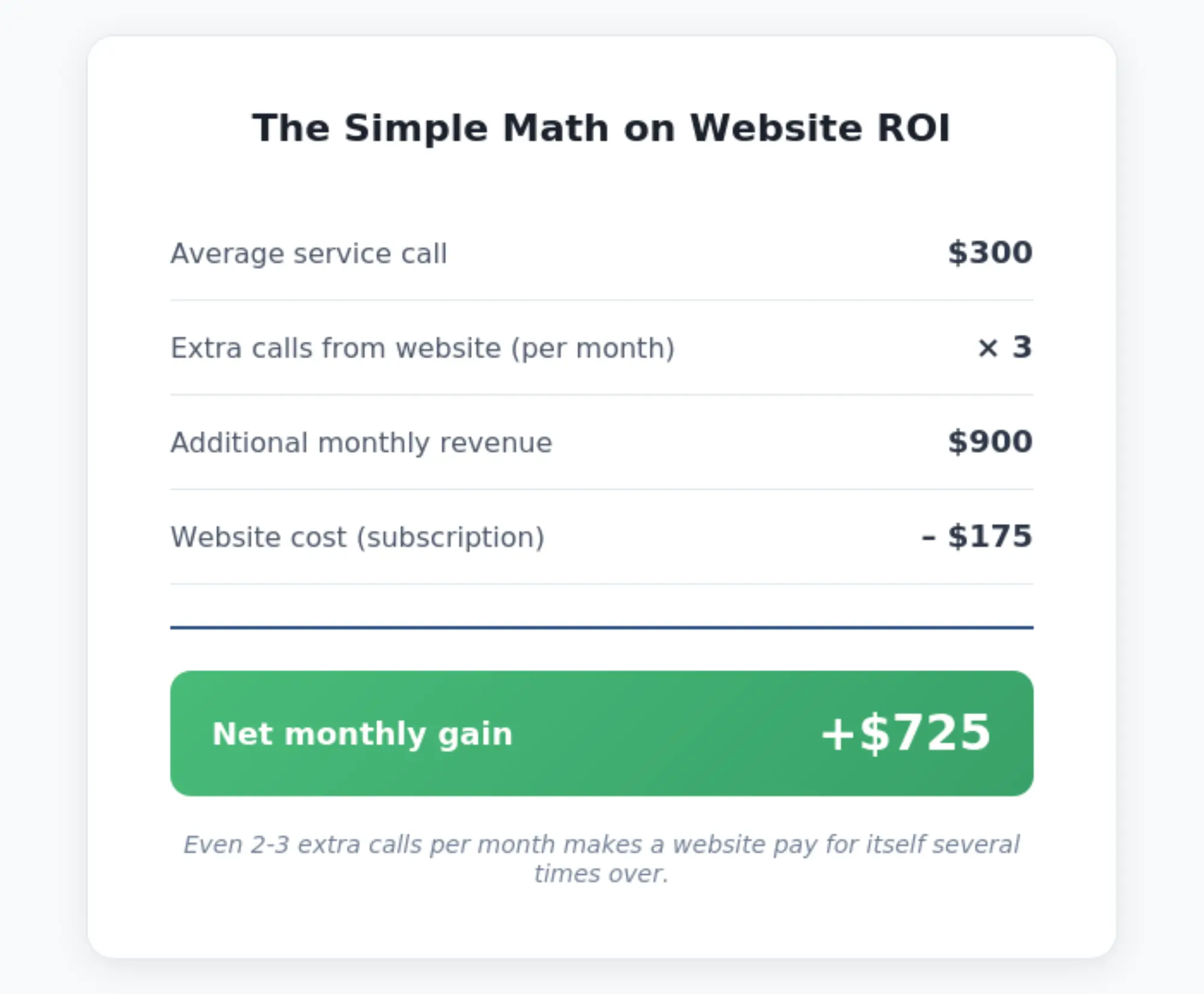
My own subscription model is $175 per month with no upfront cost, which includes the site, hosting, maintenance, and ongoing support.
But here's how I'd encourage you to think about it: if your average service call is $300 and a website brings you even two or three extra calls per month, it pays for itself several times over. The question isn't "can I afford a website?" It's "can I afford to keep missing the jobs I don't even know about?"
For a more detailed breakdown, you can read my full article on website costs here.
So, Do You Actually Need a Website?
Let me bring this back to where we started.
If you're genuinely maxed out on work, happy with your current business size, and have a reliable referral network that shows no signs of slowing down, you might be fine without a website. I mean that sincerely. Not every plumber needs one, and I'm not in the business of selling people things they don't need.
But if you've ever wondered why work slows down at certain times of year, or lost a job to a competitor you know you're better than, or wished you had more control over where your leads come from, or thought about growing your business beyond where it is today — then the answer is probably yes.
Not because some marketing person told you so. But because the math makes sense.
A website isn't a magic bullet. It's a tool. But for most plumbers, it's a tool that pays for itself quickly and keeps working long after you've stopped thinking about it.
What's Next?
If you're not sure whether a website makes sense for your situation, I'm happy to talk it through. No pitch, no pressure — just an honest conversation about what might actually help your business.
And if you want to understand what a website actually costs, I put together a detailed breakdown covering DIY platforms, freelancers, agencies, and everything in between. You can read that here.
Frequently Asked Questions
How much does a plumber website cost?
It ranges quite a bit. DIY platforms run $200-500 per year plus your time. Freelancers typically charge $2,000-5,000. Agencies start around $8,000 and go up from there. Subscription services like mine run $175 per month with no upfront cost.
What pages does a plumber website need?
At minimum: a homepage with your phone number and service area, a services page listing what you offer, an about page with your licensing and background info, and a contact page. Photos and testimonials can go on the homepage or have their own sections. Most plumber sites don't need more than five to seven pages total.
Do I need to offer online booking on my website?
It depends on how you run your business. For plumbing, especially emergency work, most customers still prefer to call. Online booking can be convenient for routine maintenance, but it's a nice-to-have, not a must-have. At minimum, make sure your phone number is prominent and easy to tap on mobile.
How do I rank for "plumber near me" searches?
This is local SEO, and it's a combination of your website and your Google Business Profile. Make sure your GBP is fully optimized with accurate service areas, your website mentions the specific cities you serve, and you're actively collecting Google reviews. I've written more about local SEO for small businesses if you want the full breakdown.
Should I mention that I offer 24/7 emergency service?
Absolutely — if you do. Emergency calls are often the highest-value jobs in plumbing, and people searching at 2am need to know immediately that you're available. Put it in your homepage headline, in your header, everywhere it makes sense. That's a major differentiator.
How long does it take for a website to start generating leads?
It varies depending on competition in your area and how well the site is optimized. Some plumbers see calls within a few weeks. For most, it takes two to four months to build momentum in search results. Collecting Google reviews consistently helps speed this up significantly.