Do Roofers Really Need a Website in 2026?

Do Roofers Really Need a Website in 2026?
If you've been in the roofing business for any length of time, you've probably heard this before:
"You need a website to grow your business."
And your response (which is completely fair) might be something like: "I've got more work than I can handle. My phone doesn't stop ringing after every big storm. Why would I pay for a website?"
Honestly? You might be right.
I've talked to roofers who've been in business for 20 years, have a full crew, and have never spent a dollar on marketing beyond a truck magnet and a yard sign. Word of mouth and storm season take care of everything.
So I'm not going to tell you that you absolutely need a website. That would be dishonest, and frankly, it's not the kind of advice I give.
What I am going to do is walk through the specific things about the roofing industry that change the math compared to other trades, because there are a few, and they matter more than most roofers realize.
When Referrals Really Are Enough
Before I make any case for having a website, I want to be honest about when you genuinely don't need one.
If your crew is booked three months out and you're turning away jobs, you don't need more leads. You need to raise your prices. If you've been in the same community for 15 years and your reputation opens every door for you, that network might be all you need. If you're winding things down and not trying to grow, investing in a website probably doesn't make sense.
Referral-based businesses have real advantages. Zero marketing cost. Warm leads with built-in trust. Higher close rates. And the mental bandwidth to focus on the work instead of the marketing.
If that's genuinely where you are, you might be fine.
But there's one thing about roofing specifically that I want you to think about before you close this tab.
The Scammer Problem (And Why It Matters for Your Business)
Roofing has an image problem, and it's not your fault.
Every time there's a major storm, an army of out-of-state contractors rolls into town: guys who knock on doors, collect deposits, do shoddy work or disappear entirely, and are gone before the homeowner realizes what happened. It happens in every market, after every significant weather event. Homeowners know it, insurance adjusters know it, and it makes people deeply suspicious of any roofer they haven't personally met before.
This is the thing that changes the calculus for roofing more than almost any other trade: your biggest competition isn't other legitimate roofers. It's the perception that you might not be one.
When someone is looking for a roofer, especially after storm damage when they're stressed and their home is vulnerable, they are actively trying to figure out who is legitimate and who is a scammer. They're Googling you. They're looking for reviews. They're looking for a license number. They're trying to find any evidence that you're a real, established business that will still be around if something goes wrong.
If they Google your company name and find nothing, some of them will call anyway. But a lot of them won't. Not because they don't believe you're good at your job, but because they've seen the news stories, they've had a neighbor get burned, and they're not taking chances with a $15,000 roof.
A professional website with your license number, your insurance certificate, photos of your completed work, and a handful of real reviews from local homeowners is the single most effective way to answer that question before it's even asked. It tells the story you want told before someone else's skepticism tells a different one.
The Hidden Cost of Being Invisible After a Storm
Here's a scenario worth thinking through.
A hailstorm rolls through your area on a Thursday afternoon. By Friday morning, homeowners across three counties are outside looking at their roofs, calling their insurance companies, and Googling "roofing companies near me."
Some of those homeowners know a roofer personally. Most don't. The ones who don't are going straight to Google, and they're calling whoever shows up.
If you're not showing up in that search, you're invisible in the highest-demand moment of your entire year. Those jobs are going to whoever is findable. Not necessarily the best roofer in the area, just the one who exists online.
Roofing jobs aren't $300 service calls. They're $8,000, $15,000, $25,000 projects. Missing even two or three of those post-storm inquiries because you weren't findable is a significant dollar amount to leave on the table. The math on a website paying for itself is faster in roofing than in almost any other trade.
Even Your Referrals Are Vetting You Online
This is something I bring up with every contractor I talk to, and it hits differently in roofing.
Someone's brother-in-law says, "Use my roofer, he did a great job on our house last year." The homeowner nods and then, before they ever pick up the phone, they search your company name. They're not trying to find someone else. They're trying to confirm that the person they're about to call checks out.
What do they find when they search you?
A professional website with photos of real completed jobs, a license number, a few testimonials, and your service area creates instant confidence. It confirms the trust that referral started.
A Facebook page that hasn't been posted to in eight months raises questions. And finding nothing at all? In roofing especially, that's enough to make a lot of people move on.
This isn't about distrust in you personally. It's about the industry reputation problem I mentioned earlier. The bar for "looks legitimate" is higher for roofers than it is for, say, a house painter or a landscaper. A website clears that bar. The absence of one leaves doubt.
The Seasonality Problem
Most roofing businesses have a feast-or-famine rhythm that's baked into the trade. Storm season or peak installation months, the phone doesn't stop. Then the off-season hits and things get quiet, sometimes a lot quieter than you'd like.
The contractors I've talked to who run the most consistent businesses year-round are usually the ones generating their own leads instead of waiting for the phone to ring. And the best way to generate leads consistently is to be findable when someone needs a roof, regardless of whether there was a storm last week.
A website that's optimized for local search works in February when things are slow just as well as it works in June when things are busy. It captures the homeowners who were planning a roof replacement anyway, the people whose insurance adjuster finally approved a claim from last season, the folks who've been putting it off and finally decide to pull the trigger during a calm week.
Referrals spike after storms. A website levels things out.
"But I Have a Facebook Page"
I hear this one a lot, and I want to address it honestly.
Facebook is useful: great for before-and-after project photos, staying visible with past customers, and running targeted ads in your market. But it doesn't replace a website, for one very practical reason: Facebook doesn't show up in "near me" searches.
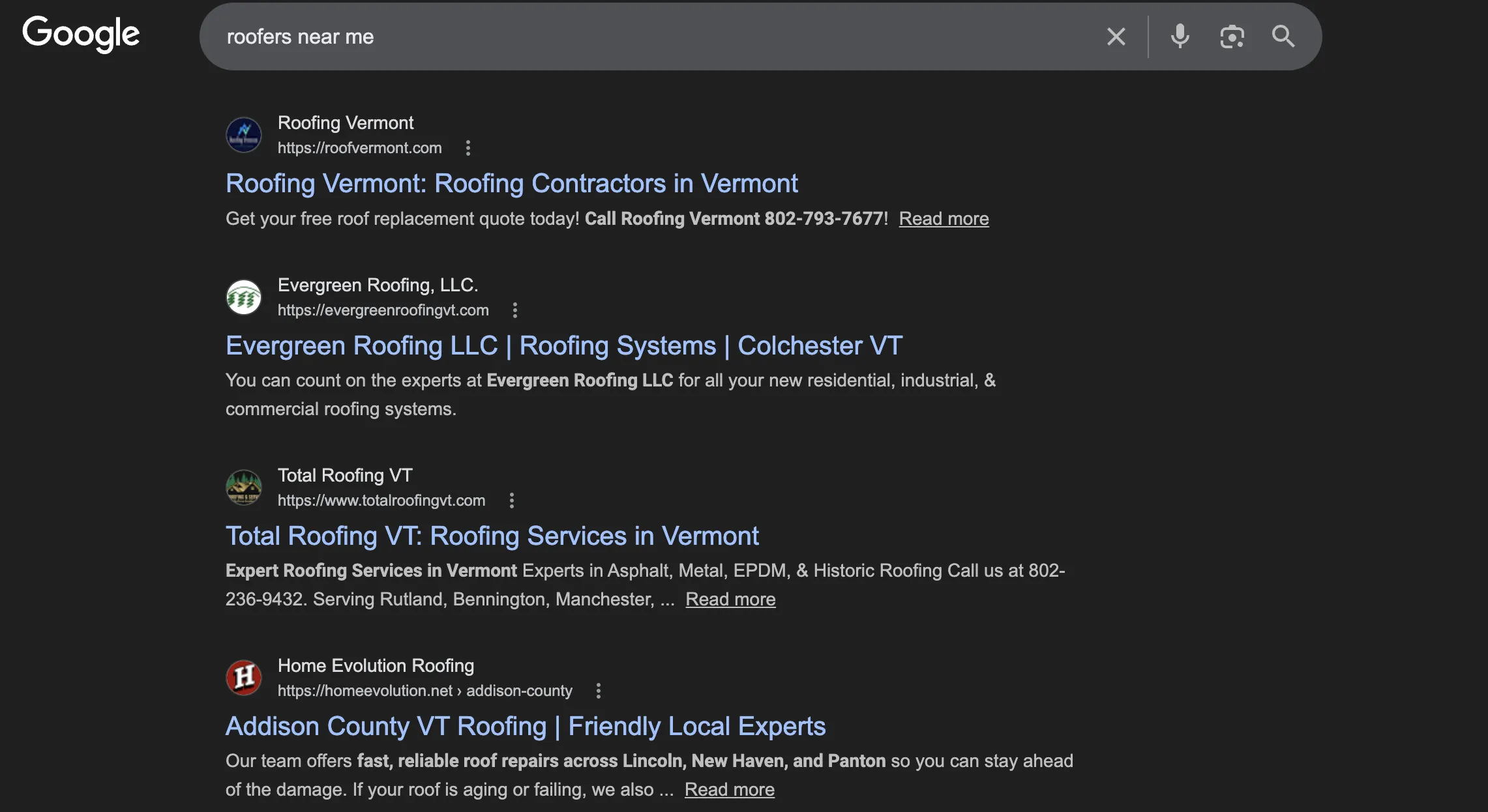
When someone searches "roofer near me" or "roofing company [your city]," Google surfaces websites and Google Business Profiles. It doesn't surface Facebook pages. So if Facebook is your only online presence, you're invisible to every homeowner who goes straight to Google, which in 2026 is most of them.
There's also the trust dimension. In an industry where homeowners are actively trying to distinguish legitimate businesses from storm chasers, a Facebook page alone doesn't carry the same weight as a real website. It's better than nothing, but it's not the same thing.
Use Facebook for engagement. Use a website for being found.
What About Google Business Profile?
Google Business Profile is one of the best things a roofing company can set up, full stop. It's free, it shows up prominently in local search, it drives calls, and it's where your reviews live. If you don't have one yet, that's your first move.
But here's how I'd encourage you to think about GBP and a website: they're not competing with each other. They do completely different jobs.
Your Google Business Profile is where people find you. Your website is where they decide to hire you.
When someone searches "roofer near me" after a storm, your GBP is what puts you on the map, sometimes literally. It gets you the click, the phone call, the visit. That's its job and it does it well.
But once a homeowner lands on your profile, they're looking at a box in a list of boxes. Your name, your star rating, a few photos. Every other roofer in that list has the same box. At that point, the homeowner is doing one of two things: calling the first number they see, or clicking through to your website to figure out whether you're the right call to make.
That click-through is where the conversion happens, or doesn't.
A GBP profile can tell someone you exist. A website tells them who you are, shows them your work, answers their questions, displays your license and certifications, and gives them every reason to pick up the phone and call you instead of the next guy in the list. It's the difference between a billboard on the highway and the showroom you walk into after you've seen the billboard.
You need both. GBP gets the traffic. Your website closes it.
What a Roofing Website Actually Needs
Here's the good news: you don't need a complicated website. You don't need a blog, you don't need twenty pages, and you definitely don't need fancy animations that slow everything down.
What you do need:
Your license and insurance information, prominently displayed. This is non-negotiable in roofing. Put your contractor license number on your homepage. Mention that you're insured and bonded. This isn't bragging. It's answering the question every potential customer is silently asking before they decide whether to call.
Before-and-after photos of real jobs. Roofing is a visual trade in a way that's easy to underestimate. A homeowner who sees a photo of a roof that looks like theirs, same style, same neighborhood, same kind of damage, and then sees what it looks like after you're done is already halfway sold before they've talked to anyone. No stock photos. Real roofs, real work.
Your phone number visible on every page. In the header. Large enough to read on a phone. Tappable. Post-storm, people are not hunting for contact information. They're making quick decisions. Make it effortless to call you.
A service area. List the counties or cities you serve. This helps with local search rankings and tells people immediately whether you can help them.
Reviews from real customers. Even three to five solid testimonials make a real difference. If you've got good Google reviews, feature them on your site. Social proof from recognizable local names and neighborhoods carries a lot of weight in roofing.
Your years in business and any certifications. GAF Master Elite, Owens Corning Preferred, CertainTeed SELECT ShingleMaster: if you have them, display them. Manufacturer certifications are signals that you're trained, established, and accountable. Storm chasers don't have them.
That's honestly most of it. A fast, clean, mobile-friendly website with those elements will outperform the majority of roofing websites out there. Not sure what to write on your homepage? Our free contractor copy generator can put together a solid first draft in a couple of minutes.
The Cost Reality
I won't rehash all the pricing details here. I've got a full breakdown in my website cost article if you want to dig into the numbers. But here's the quick version:
DIY with Wix or Squarespace: $200-500 a year, plus 20-40 hours of your own time. A freelancer: $2,000-5,000 for a basic site, plus ongoing maintenance to figure out. An agency: $8,000 and up, often significantly. My subscription model: $175 a month, no upfront cost, includes the site, hosting, maintenance, and support.
But here's the frame I'd encourage you to use: if your average roofing job is $12,000 and a website brings you one additional job over the course of a year, it's paid for itself many times over. Most contractors I work with see more than that. The math in roofing moves faster than almost any other trade, precisely because the average ticket is so high.
So, Do You Actually Need One?
If your crew is booked solid, you're turning away jobs, and your referral network shows no signs of slowing down, you might genuinely be fine without one. I'll say that as honestly as I can.
But if you've ever wondered why the phone goes quiet between storms, or lost a job to a competitor you know doesn't do work as good as yours, or had a homeowner tell you they almost didn't call because they couldn't find much about you online: you already know the answer.
A website won't make you a better roofer. But it will make sure the right homeowners can find you, trust you, and call you before they call someone else.
If you want to talk through whether it makes sense for your specific situation, I'm happy to do that. No pitch, no pressure, just an honest conversation. Reach out here.
Frequently Asked Questions
What should a roofing company website include?
At minimum: your license and insurance info, photos of completed jobs (before and after), your service area, your phone number in the header, and a few customer testimonials. Manufacturer certifications like GAF Master Elite or Owens Corning Preferred are worth displaying prominently. They're trust signals that most storm-chasing operations can't match.
How much does a roofing company website cost?
It depends on how you build it. DIY platforms like Wix or Squarespace run $200-500 a year plus your time. A freelancer typically charges $2,000-5,000. Agencies start around $8,000. My subscription model is $175 a month with no upfront cost, which includes the build, hosting, maintenance, and support.
How do I get my roofing company to show up on Google?
It's a two-part system: your Google Business Profile gets you found, your website converts that traffic into calls. Your GBP needs to be fully built out with accurate service areas, real photos, and a steady stream of reviews. That's what earns you a spot in the local map pack. Your website handles what happens after someone finds you: it answers their questions, shows your work, and gives them every reason to call you instead of the next name on the list. You need both, and they work best together.
Should I have a roofing website if I mostly do insurance work?
Absolutely, and arguably more so. Homeowners navigating an insurance claim are often unfamiliar with the process and looking for someone they can trust to guide them through it. A website that explains how insurance claims work, what to expect from the process, and what your role is as their contractor builds an enormous amount of trust before you ever shake someone's hand.
How long before a website starts generating roofing leads?
It varies by market and how competitive your area is. Some roofing contractors start seeing inbound calls within a few weeks of launching. For most, three to five months is a reasonable timeline to start seeing consistent results from organic search. Strong Google reviews speed this up significantly.