Does SEO Work for Small Business? 6 Months of Real Data

Do Small Businesses Need SEO? Here's What 6 Months of Real Data Actually Shows
It's one of the most common questions I get.
"I keep hearing that SEO is important, but does it actually work for a small business like mine? Or is it just something big companies with big marketing budgets do?"
I've written about this before from a strategic angle — when it makes sense, when it doesn't, what to realistically expect. But this time I want to skip the theory and just show you the numbers.
What follows is a real case study. A real client, a real website we built from scratch, and the real Search Console data from the first six months. I'm keeping the client anonymous, but everything else — the content architecture, the keyword data, the screenshots — is unedited.
If you've ever wondered whether SEO is actually worth it for a small business, this should answer it pretty clearly.
Let's get into it.
The Client: A General Contractor With No Online Presence
When this client came to us, they had basically no online presence worth speaking of. A homepage. Maybe a contact page. No service-specific pages, no location pages, no content strategy of any kind.
Sound familiar?
They were getting almost all of their work through word of mouth and referrals — which was working fine, until it wasn't. Referrals have a natural ceiling. They're slow, unpredictable, and entirely dependent on the conversations your previous clients happen to have with their neighbors. When things slow down, you have no lever to pull.
The goal was simple: build a website that generates leads from people actively searching for what they do, in the specific areas they serve. No paid ads. No social media strategy. Just SEO, done right, from day one.
The Strategy: Hub and Spoke Architecture
Before writing a single word of copy, we mapped out the content architecture. This is the step most people skip, and it's also the step that matters most.
The idea behind hub and spoke SEO is straightforward: your homepage is the hub. Every major service gets its own dedicated page (a spoke). Sub-services get their own pages below that. And if you serve multiple geographic areas, each location gets its own page too.
Here's the architecture we built:
Content architecture diagram built for this case study
The site ended up with 15 pages total:
Service Pillar Pages (spokes off the hub):
- New Construction
- Renovations (parent page)
- Kitchen Remodeling
- Bathroom Remodeling
- ADUs (Accessory Dwelling Units)
- Decks & Porches
- Home Additions
- Roofing
- Concrete
- Foundations
- Patios
Location Pages:
- Portland
- Lewiston
- Auburn
Why So Many Pages? Can't You Just Put It All On One?
This is the question I get every single time I explain this strategy to a client. And I get it — 15 pages sounds like a lot. Wouldn't it be simpler to just have one big "Services" page that covers everything?
Technically yes. But here's the problem: Google can't rank a single page for 10 different things. At least not well.
When someone searches "adu builders Maine," Google is trying to find the best possible result for that specific query. A page that says "we do new construction, renovations, decks, ADUs, roofing, concrete, and more" doesn't signal to Google that you're particularly relevant or authoritative for ADUs specifically. You're diluted.
A dedicated page that's entirely focused on ADUs — with its own H1, its own copy explaining what ADUs are, your experience building them, FAQs about the process, and the geographic area you serve — that page sends a very clear signal. "This page is specifically about building ADUs in Maine."
It's the difference between a generalist and a specialist. Google rewards specificity.
The same logic applies to the location pages. Your homepage might mention that you serve Lewiston, Auburn, and Portland. But a dedicated Portland page — with copy about working in Portland's historic neighborhoods, handling Portland's permitting process, and your experience building in that specific area — can rank for "general contractor Portland Maine" in a way your homepage simply can't.
The Results After 6 Months
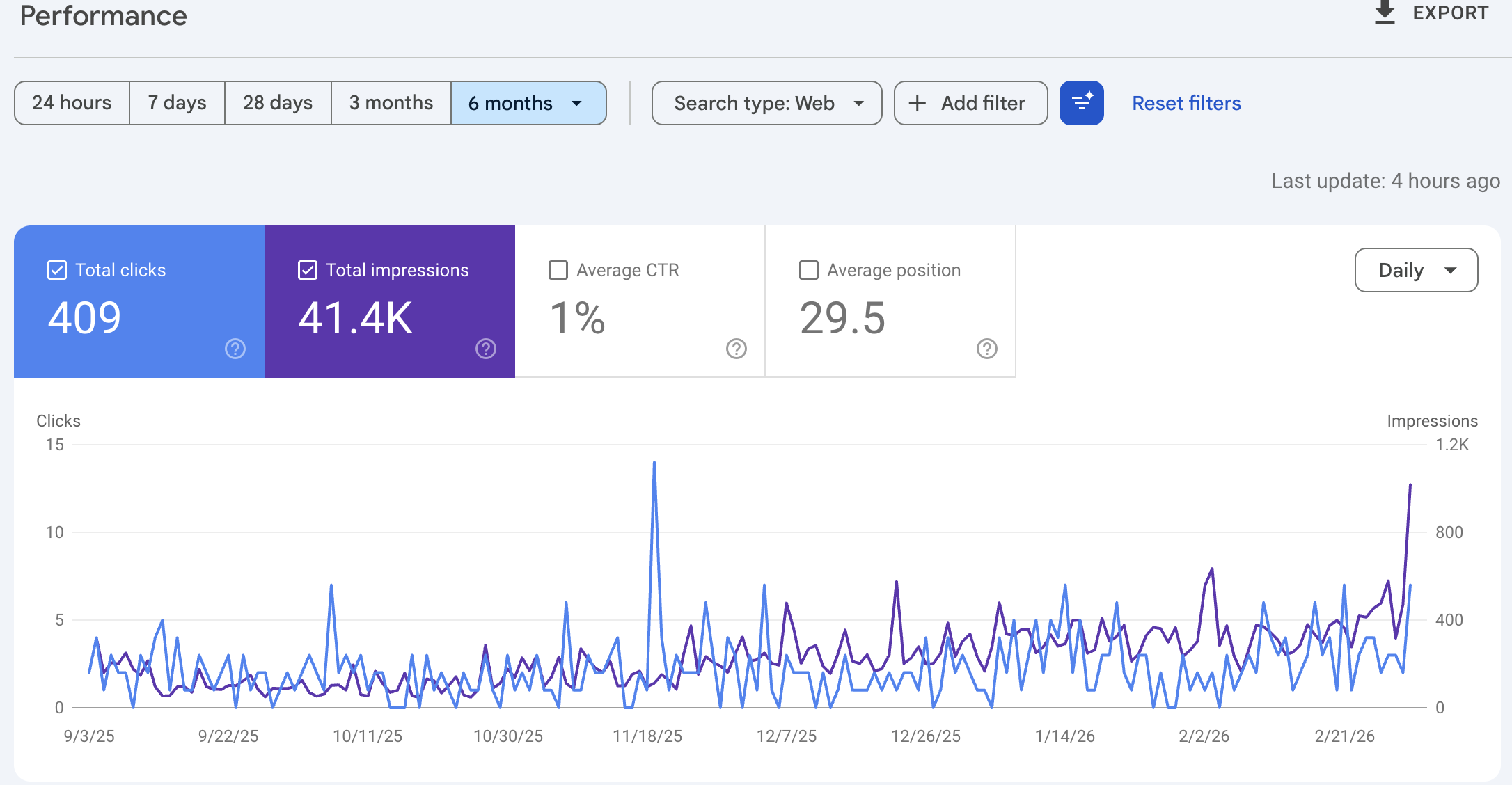
Six months after launch:
- 41,400 total impressions
- 409 clicks
- Average position: 29.5 (and climbing — most of these rankings are under 6 months old)
The impressions trend tells the real story. In September, the site was barely registering. By late February, it was seeing close to 1,200 impressions per day — and that number was still going up at the time of this writing.
That's what SEO momentum looks like. It's slow at first. Then it compounds.
The Breakout Star: The ADU Page
Here's where it gets interesting.
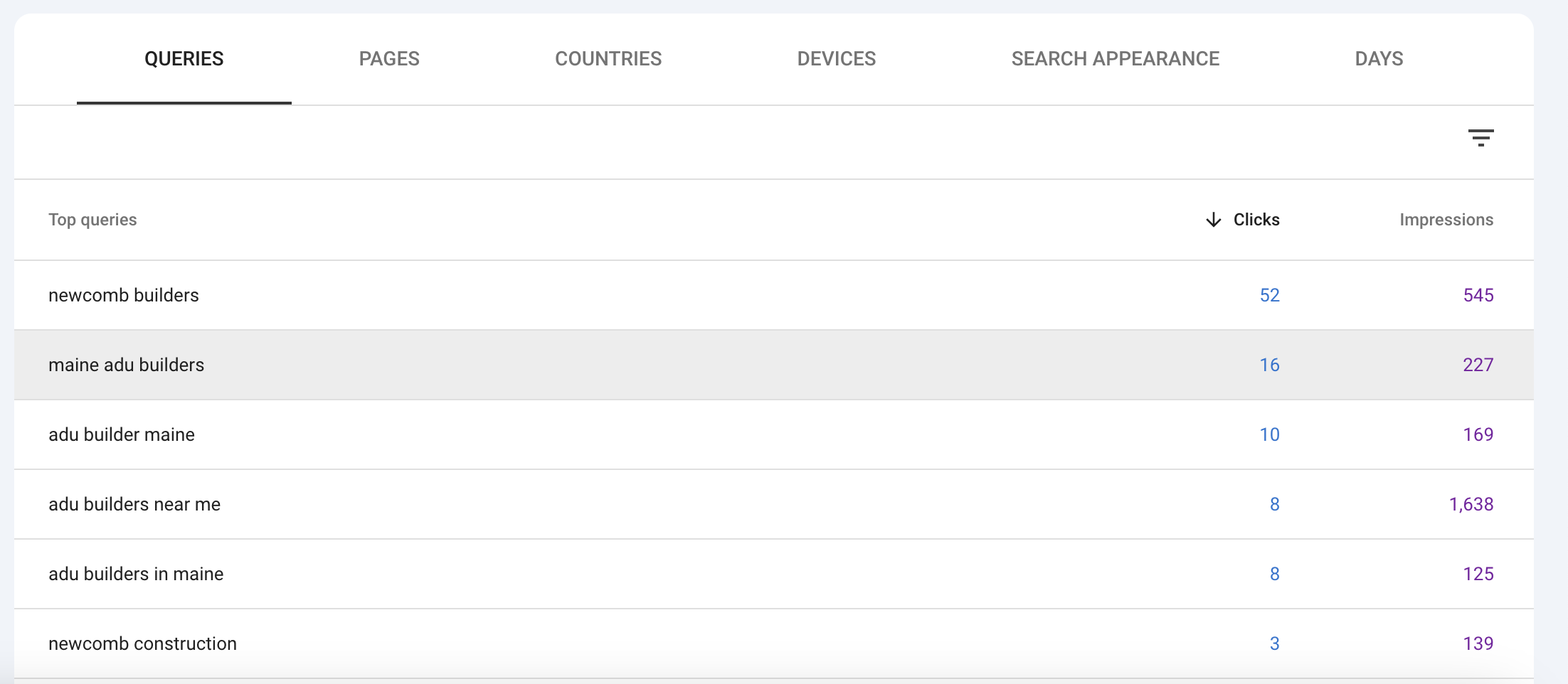
Look at the top queries. The ADU-related keywords absolutely dominate the list:
- "adu builders near me" — 1,638 impressions
- "maine adu builders" — 227 impressions
- "adu builder maine" — 169 impressions
- "adu builders in maine" — 125 impressions
- "adus near me" — 280 impressions
- "adu contractors near me" — 155 impressions
- "adu architect near me" — 157 impressions
- "adu builder near me" — 85 impressions
Add those up and the ADU cluster alone accounts for over 2,500 impressions — more than half the site's total, from a single dedicated page.
Why? Because when we built the site, nobody else in Maine had a dedicated ADU page. The competition for that keyword cluster in this market was essentially zero. One well-structured page for an underserved niche became the biggest traffic driver on the entire site.
This is the part of local SEO that most small businesses completely miss. They're all fighting over "general contractor Maine" while nobody's bothered to claim "adu builders Maine." Find the gap. Build the page. Rank.
What's On Each Page (And Why It Matters)
The architecture is only half the equation. The pages themselves need to be built correctly.
Here's what went into each service page:
A clear, keyword-optimized H1. Not "Our Services" — something like "Bathroom Remodeling in Central Maine: Lewiston-Area Contractor." The H1 tells Google exactly what the page is about and where it's relevant.
Geographic specificity baked into the copy. Not just "we serve the area" — specific towns, county names, references to local permitting processes. Google reads this and understands the geographic relevance of the page.
FAQPage schema markup. Every service page has a full FAQ section with structured data. This gives the page a chance to show up in the "People Also Ask" boxes in search results — free additional visibility that most contractors never bother with.
A clear call to action with the phone number. Every page ends with a direct prompt to call. The goal of all of this is a phone ringing, not a nice-looking website. Writing this kind of copy doesn't have to be painful, either — if you want a head start, try our free contractor copy generator.
Internal links between related pages. The bathroom remodeling page links to the home additions page. The foundations page links to the concrete page. This internal linking structure tells Google how the pages relate to each other, reinforces topical authority, and passes link equity around the site.
The Location Pages: Why They Exist
The location pages are often the last thing clients want to prioritize. "We already have a homepage that mentions Portland and Lewiston — why do we need separate pages?"
Because "general contractor Portland Maine" is a search query with real local intent, and your homepage can't rank for it as well as a dedicated Portland page can.
Each location page:
- Targets city-specific keyword combinations ("home addition contractor Lewiston", "kitchen remodeling Auburn ME")
- References the specific towns, neighborhoods, and permitting processes relevant to that city
- Links back to the relevant service pages, building the internal link structure
- Creates another entry point into the site — someone searching by city finds the location page, then navigates to the service they need
It's a different entry point into the same funnel, and it captures searches that the homepage and service pages simply can't rank for.
How Long Did It Take?
The site launched in early September 2025. For the first 6-8 weeks, the numbers were basically flat. A handful of impressions here and there — mostly branded queries for the company name.
Starting around late October, impressions began climbing. By January, there was a clear upward trend. By late February, the site was seeing its highest daily impression numbers yet, and they were still climbing.
This is the part that frustrates people about SEO, but it's also the part that makes it valuable. It's slow to build. Once it builds, it compounds. The pages you publish today can rank for years without any additional investment.
Paid ads turn off the moment you stop paying. SEO keeps working.
What This Looks Like As a Strategy
Here's the framework, boiled down:
Map your services first. Every distinct service gets its own page. If customers search for it separately, it deserves its own URL.
Build location pages for every area you serve. One page per major city or market. Keep the copy unique — don't just swap out the city name.
Use FAQPage schema on every service page. It's free visibility in search results that most contractors never use.
Internal link everything. Service pages link to related service pages. Location pages link to relevant service pages. Everything connects.
Be patient. Six months is about when you start seeing real traction for most local businesses in competitive markets. Some are faster. Some take longer. But the direction is always up if the foundation is right.
What Could Make It Even Stronger
The site is doing well for a 6-month-old domain with no paid ads and very few backlinks. Here's what would accelerate it further:
More reviews on the Google Business Profile. Reviews are still one of the biggest local ranking factors, and right now there's room to grow here.
Blog content targeting informational searches. Questions like "how much does an ADU cost in Maine" or "do I need a permit for a deck in Lewiston" — these are searches potential customers are already doing. Pages that answer those questions bring in top-of-funnel traffic that service pages can't capture.
More location pages. Mechanic Falls, Poland, Turner, Sabattus — these are towns within the service area that don't have dedicated pages yet. Each one is a ranking opportunity.
Backlinks. The site has almost none right now. Even a handful of quality local links — from a Chamber of Commerce directory, a local business association, a supplier — would meaningfully accelerate the rankings.
The Bottom Line
The hub and spoke content architecture isn't complicated. But it requires doing the work upfront — mapping the pages, building them correctly, and then waiting for Google to catch up.
Most small businesses have one or two pages and wonder why they're not ranking. The answer is almost always: you're not giving Google enough specific signals about what you do and where you do it.
Build the pages. Use the schema. Link internally. Be patient.
It works.
Want to see what this architecture might look like for your business? Book a free call and we can map it out together.
Frequently Asked Questions About Small Business SEO
Does SEO actually work for small businesses?
Yes — but the results depend heavily on how it's implemented. Generic, thin websites with no content strategy rarely rank. A site built with clear service pages, geographic targeting, and proper on-page SEO can see meaningful traction within 3-6 months, as this case study shows.
It depends on how many distinct services you offer and how many geographic markets you serve. For most local service businesses, somewhere between 10 and 25 pages hits the sweet spot — enough to capture specific keyword intent without spreading the content too thin.
How long does it take to see results from this kind of strategy?
For most local businesses, you'll start seeing meaningful impressions within 3-4 months and meaningful click traffic within 5-7 months. It's slower than paid ads, but the results compound over time in a way that paid ads don't.
Do you need to write blog posts for this strategy to work?
No. The case study above has no blog posts at all — just well-structured service and location pages. Blogging helps and can accelerate results, but it's not required for this foundational architecture to work.
What is FAQPage schema and why does it matter?
FAQPage schema is a piece of structured data code that you add to a page to tell Google that the page contains a list of frequently asked questions. When Google recognizes this, your page may show up with the FAQ accordion directly in search results, giving you additional visibility beyond the standard blue link.
What's the difference between a hub and spoke SEO strategy and just having a services page?
A single services page tries to rank for many different things at once. Hub and spoke gives each service its own dedicated URL with focused, specific content. Google rewards specificity — a page that's entirely about bathroom remodeling in Maine will rank better for bathroom remodeling searches than a page that mentions bathroom remodeling among ten other services. The same structure works for professional services. Our Vermont law firm SEO service is built on it: one page per practice area.
Like this post? Make Esker one of your preferred sources so our work shows up higher in your Google results.