How Long Does SEO Take for a Contractor Website? (Real Data Inside)

Key Takeaways
- SEO for a new contractor website typically takes 3–6 months before you see real traction
- The first 60 days are almost invisible — that's normal, not failure
- Impressions come before clicks. Clicks come before calls. Patience is the strategy.
- Local contractor SEO can move faster than national niches — but only if the foundation is right
The first question almost every new client asks me is some version of this:
"How long until we show up on Google?"
It's also the most frustrating question to answer — not because I don't know, but because everyone who answers it says the same thing. "Three to six months." Which is technically true and almost completely useless, because nobody ever shows you what those three to six months actually look like.
So I'm going to do that here.
What follows is real Search Console data from Metal Vista Roofing, a Vermont-based roofing contractor serving markets across the border in upstate New York. The data is unedited. Month by month, impression by impression, this is exactly what happened after we launched their site from scratch.
No vague timelines. No theory. Just what actually happened, and why.
Why SEO Takes Time — In Contractor Terms
Here's the way I explain it to clients who don't want to hear about algorithms.
Google is like a potential customer who's never heard of you. They're not going to refer their neighbor to you after one interaction. They need to see you show up consistently — the same name, the same location, the same services — before they start putting you in front of other people.
A brand new website has no track record. No backlinks. No history. No proof that it's worth ranking. Google actually tests new pages at low visibility first, watches how real people interact with them, and then decides whether to push them higher in the results.
That's not a bug. That's what keeps spammy sites from winning overnight.
And here's a number worth sitting with: only 5.7% of pages ranking in Google's top 10 were published within the past year. Most of what's ranking has been around for a while. So when you launch a new site and it's not on page one by month two, you're not doing something wrong. You're just new.
The question isn't whether it works. It's whether you're willing to wait long enough to find out.
The Real Timeline: Month by Month
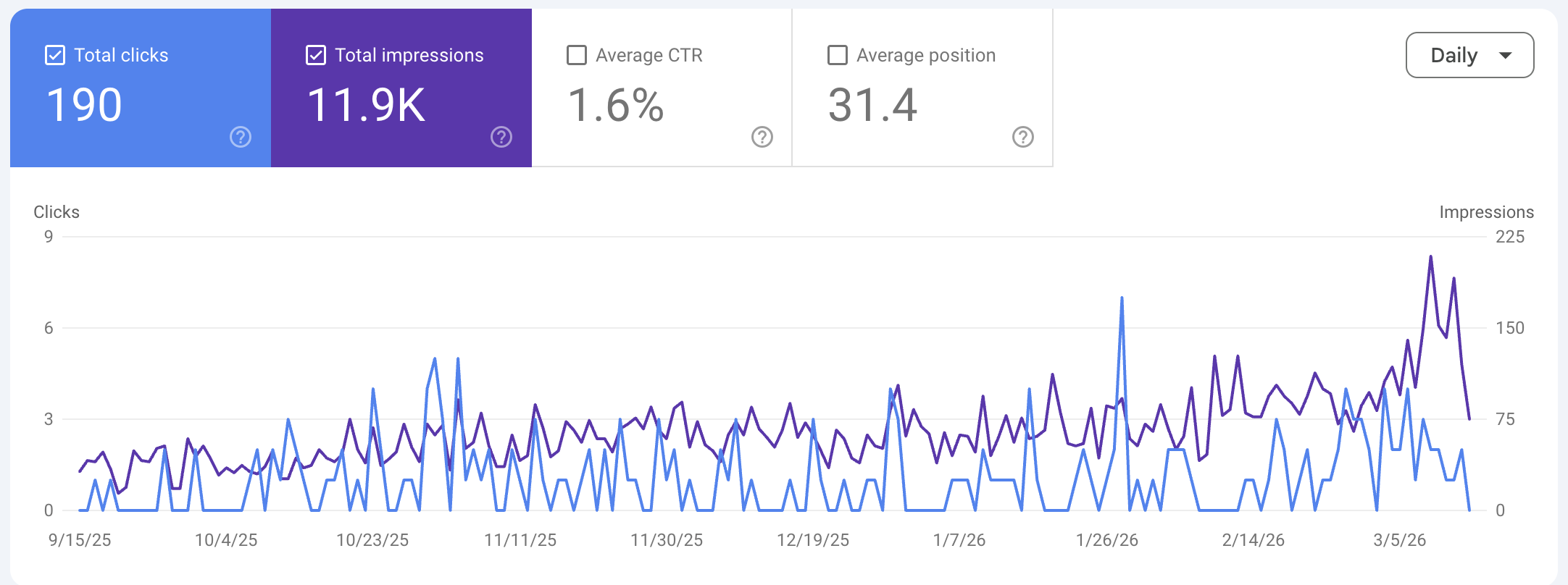
Over six months, Metal Vista Roofing went from zero to 11,900 impressions, 190 clicks, and an average position of 31.4 — with the curve still climbing at the end of the period. Here's the aggregate, month by month:
Real data from Metal Vista Roofing — six months from a brand new website.
Here's what each phase actually looked like.
Months 1–2: The Dead Zone
This is the part nobody warns you about clearly enough.
Almost no impressions. Almost no clicks. If you're checking Search Console every day during this period, you're going to convince yourself it isn't working. It is working — it just doesn't look like it yet.
Behind the scenes, Google is crawling the site, indexing the pages, and trying to figure out what they're about and where they should rank. This is the period where the technical foundation matters most. Is the site fast? Is it mobile-friendly? Is Search Console set up and verified? Is the Google Business Profile live and connected? Is content being published consistently?
If you're doing all of that, then the flat left side of the graph isn't failure. It's the runway before takeoff.
Months 3–4: The Spark
This is when things start moving — quietly at first, but they move.
Impressions start climbing. Google is beginning to surface the site for relevant searches, even if people aren't clicking yet. Average position is still rough — page two or three for most queries. You might see a handful of clicks trickling in each day.
This is the stage where most people give up. They've been waiting three or four months, they're not getting calls, and they decide it isn't worth it. I've seen it happen more than once.
The problem is that quitting at month four is like pulling a cake out of the oven ten minutes early and deciding baking doesn't work.
Months 5–6: The Momentum
This is where the graph starts curving upward in a way that's hard to ignore.
For Metal Vista, impressions accelerated toward a total of 11,900 over the six-month period. 190 clicks — real people, actively searching, finding a real business. And critically, the average position of 31.4 was still improving at the time we pulled this data, which means the best rankings hadn't even been reached yet.
The part that makes me most optimistic about where these numbers go next: most of the pages were still under six months old when this data was captured. Domain authority builds over time. Pages that are ranking at position 31 today can be ranking at position 8 by month 12, without publishing a single new piece of content.
What Actually Speeds It Up — Or Slows It Down
Contractors understand cause and effect better than most. So let's talk about the variables.
Things that speed it up:
A fast, mobile-friendly, well-built site matters more than most people think. Technical performance isn't glamorous, but Google cares about it. A site that loads in under two seconds signals quality. A site that takes six seconds to load signals the opposite.
Having your Google Business Profile active and optimized from day one is probably the single highest-leverage thing you can do in the first 30 days. It doesn't replace the website — but it works alongside it to tell Google who you are and where you operate.
Publishing location-specific content consistently, even one or two pages a month, keeps the site active and gives Google more material to index and test.
Early citations — local directories, supplier websites, Chamber of Commerce listings — build credibility with Google before your domain has any history of its own.
Things that slow it down:
A slow or poorly coded site. A template that looks fine visually but loads in eight seconds is still a slow site. That hurts rankings.
No GBP, or one that's been set up and left incomplete. An incomplete profile sends the same signal as a half-finished business card.
Thin content. A five-page brochure site with 100 words per page gives Google almost nothing to work with. There's no topical depth, no geographic specificity, no reason to rank it above someone who put in the effort.
And the biggest one: stopping at month two because "it's not working."
A note on the simple site trap: I hear this all the time — "I just want something simple, a few pages, my number, and that's it." And for a brochure? That's fine. But a simple site with no SEO strategy will show up on Google eventually... on page eight. If you want the phone to ring from organic search, the site needs to be built for that from the start. Simple and SEO-ready aren't mutually exclusive — but simple and invisible often are.
What 6 Months of SEO Actually Got This Contractor
Here's where the real payoff comes in — and it's not what most people expect.
After six months, Metal Vista Roofing wasn't just showing up in their home market. They had built out location pages specifically targeting towns across the border in upstate New York — Plattsburgh, Malone, and others they'd always wanted to work in but never had a digital foothold to reach.
Go search "asphalt shingle roofing Plattsburgh NY" or "asphalt shingle roofing Malone NY" right now. Metal Vista's pages rank #1 — above Angi, above HomeAdvisor, above contractors who've been operating in those towns for years.
They started getting calls and jobs from towns they'd never worked in before. Not because of ads. Not because someone's neighbor mentioned their name at a dinner party. Because six months ago, someone built the right pages, optimized them for the right locations, and gave Google time to do its job.
That's what a well-executed six months of local SEO actually looks like.
What Comes After Month 6
Month six isn't the finish line. It's closer to the starting line for everything that comes next.
This is when SEO starts compounding in a way that paid advertising never can. The content you published in month one starts ranking better by month nine. Each new page adds to the site's overall authority. The domain trust that took six months to build makes every future page easier to rank than the one before it.
Paid ads work until you stop paying. SEO keeps working. The work you're doing today is an asset — one that appreciates over time rather than depreciating the moment you close your wallet.
Think of it less like a treadmill — where you have to keep running just to stay in place — and more like a flywheel. Slow to get moving. But once it's spinning, it takes very little to keep it going, and the momentum builds on itself.
Ready to Start the Clock?
If you're thinking about SEO for your contractor website, the honest truth is this: the best time to start was six months ago. The second best time is now.
Every month you wait is a month your competitors are building domain authority, collecting reviews, and showing up for searches you're not capturing. The gap is real, and it grows over time.
If you want to understand what this could look like for your specific business and market, I offer a free website review — no pitch, no pressure. Just an honest look at where you're at and what it would actually take to move the needle.
And if you want to see a full breakdown of what six months looked like for a different contractor — including the content architecture, the keyword data, and exactly which pages drove the most traffic — we wrote about that here.
The data's there. The path is clear. The only question is whether you're ready to give it the time it needs to work.
Frequently Asked Questions
How long does SEO take for a contractor website?
For most local contractors, you'll start seeing meaningful impressions within 3–4 months and meaningful click traffic within 5–6 months. Some markets move faster — especially if competition is low and the site is well-built from day one. Others take longer. But the direction is always up if the foundation is right.
What should I expect in the first 60 days?
Honestly? Not much that's visible. Google is crawling and indexing your site, and the numbers in Search Console will be pretty flat. This is normal. Focus on making sure your Google Business Profile is set up, Search Console is verified, and your content is publishing on schedule. The foundation work done in months one and two is what drives the results in months five and six.
Is local SEO faster than regular SEO?
Often, yes — especially in less competitive markets. A roofing contractor in a mid-sized Vermont market is going to see results faster than someone trying to rank nationally for a broad term. Local search has a smaller competitive pool, and geographic-specific content can establish relevance quickly. Here's a deeper look at local SEO strategy for small businesses if you want to get into the specifics.
Do I need a blog to rank on Google?
Not necessarily. The case study in this post and the one we published here are both examples of sites ranking well on service and location pages alone. Blogging helps — especially for capturing informational searches — but it's not required to get the phone ringing from organic traffic.
What's the biggest mistake contractors make with SEO?
Quitting too early, without question. Month two looks almost identical to month zero. Month five looks completely different. The contractors who give up at month three never find out what month six would have looked like.