Local SEO for Contractors: What Actually Works in 2026

Local SEO for Contractors: What Actually Works in 2026
In September of last year, I started managing the Google Business Profile for a metal roofing contractor in Vermont.
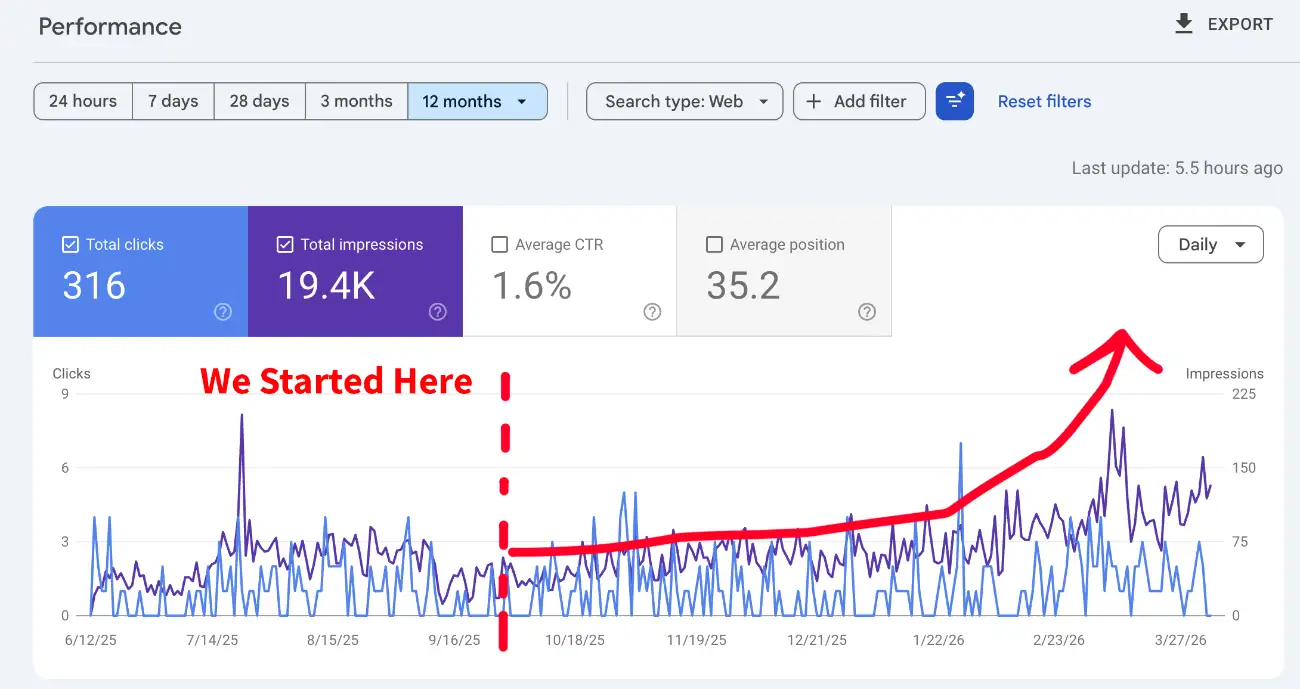
When I took over, they were getting 629 impressions a month from Google search and about 15 clicks. By March of this year — six months later — they were at 3,552 impressions and 52 clicks. Their average ranking position went from 53 to 24. They're now sitting at position 2 for "metal roofing Vermont," which is a keyword with real commercial intent in their market.
I'm going to walk you through exactly what I did, why I did it, and what the results looked like at each stage. Not because I'm trying to sell you something — though if you want help at the end, I'm easy to find — but because I think real data is more useful than generic advice, and there's a lot of generic advice out there about local SEO for contractors.
Let's get into it.
What is local SEO for contractors?
Before I get into the specifics of what I did for this client, it's worth making sure we're talking about the same thing — because "local SEO" gets used to mean a lot of different things.
Local SEO is the process of making your business show up when someone nearby searches for your trade. Not a blog post about roofing. Not a national directory listing. Your actual business, appearing in front of someone in your service area who needs what you do right now.
The most important thing to understand is that local SEO is not the same as regular SEO. In regular SEO, you're trying to rank web pages. In local SEO, you're trying to rank your Google Business Profile — specifically in what's called the Local Map Pack. That's the box with three businesses that appears at the top of search results when someone searches "roofer near me" or "plumber Burlington VT." Studies consistently show that 60–70% of clicks go to those top three spots. Position four might as well be page two.
For most contractors, that map pack is where leads actually come from. Not blog posts. Not paid ads. The map pack. And the gap between the contractor who shows up there and the one who doesn't is almost always local SEO — not experience, not price, not quality of work.
What Google actually looks at
Google ranks local businesses based on three factors: relevance, distance, and prominence. Understanding these is the foundation for everything else.
Distance is how close you are to the person searching. Unfortunately, you can't influence this one — but you can expand your businesses service area footprint over time with service area pages, which I'll get into later.
Relevance is whether Google understands what you do and believes you have the expertise to do it. This lives in your Google Business Profile and your website. If your profile is vague and your website is thin, Google has no reason to trust you over a competitor who's done more to prove their expertise. So while your Google Business Profile is the foundation of Local SEO, your website does play a part, and you should absolutely invest in one if you don't already have one.
Prominence is whether the rest of the internet confirms that you're a real, trusted business in your community. Reviews, backlinks from local organizations, consistent directory listings — these are the votes of confidence that tell Google you're legitimate. The more links and connections between your website and other websites out in the internet, the more authority that your website has, which means that Google will trust you more and reccomend you to the customers that need your products and/or services.
The reason this framework matters is simple: distance is the one factor you can't control. Given that, every bit of your energy should go into relevance and prominence — the two factors that you can actually control. That's exactly what I focused on for the roofing client, and it's what the data reflects.
Step 1: Get your Google Business Profile right
When I took over this client's GBP in September, the first thing I did was run an audit.
What I found is what I find on almost every contractor profile I look at. One primary category — roofing contractor — and nothing else. A services list with four or five entries. Thin photos (in our case, there were actually ZERO photos). A short generic description. No update post in months. This is not unusual. This is what I find on probably 80% of contractor profiles I audit. And it matters, because every empty field is a missed opportunity to demonstrate trust and relevance.
Here's what I changed and why.
Categories. Google lets you add up to 10 categories. Take advantage of that! Each category is essentially another type of search you're eligible to appear in. For this client, I added categories for metal roofing contractor, roof repair service and several others relevant to their work. More categories means more searches where Google might show you.
Services. Under each category, you can list specific services. You should have at least 20, and in competitive markets closer to 30 or 40. Each service is another signal telling Google exactly what you do. I built out their list in detail — standing seam installation, metal roof repair, asphalt shingle roofing, roof inspections, maintenance, gutter installation, gutter cleaning - essentially any possible service that you might imagine being possible on a roof? Yeah, I added it.
Description. Google gives you 750 characters. Use all of it. Include your primary trade, your service area, and what makes you different. Don't stuff a million keywords in it though — write it like a human — but make sure the basics are there.
Photos. Minimum 20 real job photos. Finished projects, before and afters, crew on site. Google wants to see that you're an active, legitimate business. Stock photos don't cut it, and will actually get you suspended by google in many cases because it will be classified and deceitful content. The photos don't need to be magazine quality; they should be relatable, professional, and representative of the work that you provide to customers. Smartphone photos are more than capable these days. Strive for at least a few uploads per month.
Posts. Regular GBP posts signal to Google that your business is active. I set up a consistent posting cadence for this client and it's one of the things I believe contributed most to the steady impression growth you see in the data after October.
That audit and cleanup took a few hours. The results started showing up in the data within weeks.
Step 2: Build a real review strategy — not just hope for reviews
Reviews are one of the biggest ranking factors in the local map pack, and most contractors treat them as an afterthought. They do great work, assume happy customers will leave reviews on their own, and end up with six reviews over three years while a competitor with half their skill has forty.
Or, they do ask they clients for reviews, but they are scared to remind them because they don't want to come across as pushing. If there is one thing you need to take away from this blog it is this: do not be afraid to send reminders when asking for reviews! People generally have good intentions, but they are also busy. If someone says "Yes, I would love to leave you a review! I will do it later today", there is about a 90% chance they will not actually do it that day... but if you follow up the next day... and two days later... and once more a week after that, they are WAY more likely to follow through, and in my experience, will thank you for the reminder. Because the reality is that they wanted to do it to help your business, they simple just kept forgetting.
For this client, I put a simple outreach process in place. Within 24 hours of a completed job, a text goes out with a direct link to their Google review page. Not "if you have a moment, we'd appreciate a review." A direct link, a brief ask, and nothing else standing between the customer and leaving feedback. I typically say something like:
"Hey this is ______ with ( insert business name here ). I wanted to follow up with you now that we have finished installing your new roof to see if you could take a minute to leave us a google review. We would love to hear your feedback, and it would really help out small business reach more customers. Thanks for considering!"
The response rate on a same-day ask is dramatically higher than one that goes out a week later. The experience is still fresh. They're still in the good feeling of having a problem solved. That's when you ask.
Beyond collecting reviews, I made sure every review got a response — positive and negative. For a roofing contractor, a thoughtful response to a critical review is actually one of the best trust signals you can have on your profile. Anyone can collect five stars. How you respond when something goes wrong tells potential customers a lot more.
Consistency matters here more than volume. Ten reviews a month for six months beats sixty reviews in one month and then silence. Google wants to see ongoing activity, not a one-time push.
Step 3: What your website needs to do for local SEO
Your Google Business Profile and your website need to tell Google the same story. If your profile says you're a roofing contractor serving Vermont and upstate New York, and your website doesn't mention those places clearly, you're creating a disconnect that quietly hurts your rankings.
The website for this client was built about a year ago. One thing I designed into it from the beginning was a set of location-specific pages — one for each market they serve across Vermont and upstate New York. Looking at the Search Console data now, those location pages are doing real work. Peru NY, Plattsburgh NY, Keeseville, Malone, Chazy — all showing up in search results and driving traffic.
A few things that matter most here:
Your homepage needs to clearly say what you do and where. "Metal roofing contractor serving Vermont and northern New York" in the first paragraph. Not buried in the footer. Not implied. Stated plainly where Google can find it immediately. If you want a deeper look at what a contractor website actually needs, I covered this in detail here.
Service area pages for every town you work in. Not copy-paste templates with the city name swapped out — actual content specific to each area. Reference the local landscape, the types of homes, the common issues. Google can tell the difference between real local content and a find-and-replace job.
NAP consistency everywhere. Your business name, address, and phone number need to be identical across your website, your GBP, and every directory where you appear. Even small differences — "Street" versus "St." — create conflicting signals that hurt your rankings.
Step 4: Citations and directories
This one isn't exciting, but it compounds quietly in the background for years.
Getting listed consistently across Yelp, Angi, Apple Maps, Bing Places, BBB, and your local Chamber of Commerce sends Google a steady stream of confirmation that you're a real, established business in your community. Chamber of Commerce links in particular carry weight — Google recognizes them as local authority signals in a way that generic directories don't.
For this client, I handled directory submissions as part of the GBP management work. The goal was simple: make sure that wherever Google looks for confirmation of this business's existence and legitimacy, it finds consistent information pointing to the same place.
It's tedious work. I won't pretend otherwise. But the contractor who has 40 consistent directory listings has a meaningful advantage over the one who has three.
How long does local SEO actually take for a contractor?
Here's where real data is more useful than any general answer I could give you.
Look at this client's timeline. The website launched first — around this time last year. For the first few months, things were relatively quiet. Impressions were bumping along in the 600–2,000 range. Solid for a new site, but not yet climbing.
GBP management started in September and October. And if you look at the data month by month, something starts to shift in October and November. Impressions stop bumping along and start climbing. Position starts dropping — from the mid-40s toward the mid-30s and then the mid-20s. By March, they had their best month on record: 3,552 impressions, 52 clicks, average position 24.7.
That's not a coincidence. The website gave Google something to point to. The GBP work gave Google a reason to actually show them. Both pieces were necessary. Neither one alone was sufficient.
For most contractors, here's the realistic timeline: GBP cleanup and optimization can show movement in the map pack within a few weeks. Citation building takes a month or two to propagate. Real traction — consistently appearing in the top three for competitive searches across your service area — takes three to six months of consistent work.
Anyone who tells you they can get you to page one in two weeks is either confused or hoping you are. I go into more detail on what the timeline looks like in different markets here.
DIY vs. hiring someone for contractor SEO
A lot of what I've described in this post is genuinely doable yourself. The GBP audit, the review outreach process, the basic website fixes — none of it requires a marketing degree. It requires consistency and attention to detail, which most contractors already have in abundance when it comes to their actual trade.
Where it gets harder is doing it consistently while also running a business. The GBP work that drove these results for the roofing client wasn't complicated — it was just showing up every week and doing the basics. Regular posts, photo uploads, review responses, monitoring. That's a part-time job on top of your actual job, and when things get busy, it's always the first thing to fall off.
If you're a contractor in Vermont or New Hampshire and you want an honest read on where your local SEO currently stands — what your GBP looks like, how you're ranking, what your competitors are doing that you're not — let's get on a call. I'll look at everything before we talk about whether working together makes sense.
Frequently asked questions
How important is local SEO for contractors?
It's where most non-referral leads come from. Studies show 76% of people who search for a local service contact a business within 24 hours. If you're not in the map pack when they search, those jobs go to someone else — and you never knew they were available.
What's the most important local SEO ranking factor for a contractor?
Your Google Business Profile is the foundation. Specifically: your categories, your services list, your reviews, and how active and complete the profile is. Everything else builds on top of that.
How do I get my contracting business to show up on Google Maps?
Claim and verify your Google Business Profile, choose the right primary and secondary categories, fill out every field, upload real job photos, and build a consistent review strategy. That's the starting point. From there, your website and directory listings reinforce the signal.
Does local SEO for roofers work the same as for other trades?
The fundamentals are the same across trades — plumbers, electricians, HVAC contractors, landscapers all work from the same playbook. The differences are in the specific keywords, the competitive landscape in your market, and how many location pages make sense given your service area. I've written trade-specific breakdowns for roofers, plumbers, and electricians if you want to go deeper on your specific trade.
Do I need a website for local SEO as a contractor?
You can get some traction with just a Google Business Profile, but your website is what separates you from the competition in a crowded market. It's also the only piece of your online presence you actually own. I wrote a full post on this question here.